



Cascada de almacenamiento de GNC frente a remolque tubular: ¿cuál es la diferencia?
 Autor:
 Tiempos:2026-08-10
 Lee:
Lee:
Puntos clave
aunqueCascadas de almacenamiento de GNCy los remolques de tubo de GNC utilizan cilindros de alta presión para almacenar gas natural comprimido, y tienen diferentes propósitos. Una cascada de almacenamiento de GNC es un sistema de almacenamiento fijo diseñado para el despacho eficiente de gas en las estaciones de servicio, mientras que unRemolque de tubo de GNCes una unidad de transporte móvil utilizada para entregar gas natural comprimido de un lugar a otro. Comprender las diferencias ayuda a los operadores a elegir el equipo adecuado para su red de distribución de gas.
Por qué la gente suele confundir estos dos sistemas
Si estás planeando unaEstación de servicio de GNCo proyecto de transporte de gas, probablemente se haya encontrado tanto con cascadas de almacenamiento de GNC como con remolques de tubo de GNC.
A primera vista parecen muy similares.
Ambos constan de múltiples cilindros de alta presión montados juntos. Ambos almacenan gas natural comprimido a presiones de hasta 250-300 bar. Ambos desempeñan papeles importantes en la cadena de suministro de gas natural.
Sin embargo, están diseñados para funciones completamente diferentes.
Elegir el sistema incorrecto puede aumentar los costos operativos, reducir la eficiencia del combustible o limitar la escalabilidad de su proyecto.
Esta guía explica las diferencias clave, ayudando a los ingenieros,EPCLos contratistas, distribuidores de gas y operadores de flotas seleccionan la solución más adecuada.
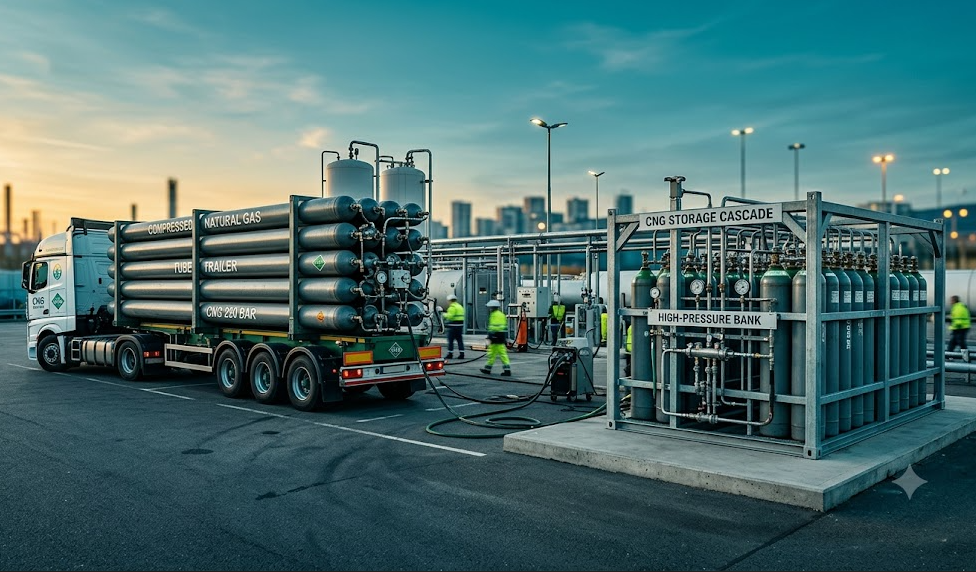
¿Qué es una cascada de almacenamiento de GNC?
Una cascada de almacenamiento de GNC es un sistema estacionario de almacenamiento de gas instalado en una estación de servicio de GNC o en una instalación industrial.
En lugar de almacenar gas en un solo recipiente, el sistema divide los cilindros en múltiples bancos de presión, generalmente grupos de presión baja, media y alta.
El gas se dispensa secuencialmente desde estos bancos, lo que maximiza la utilización de la presión y al mismo tiempo reduce la carga de trabajo del compresor.
Las aplicaciones típicas incluyen:
-
Estaciones públicas de servicio de GNC
-
Instalaciones de abastecimiento de combustible para flotas
-
Sistemas de suministro de gas industrial.
-
Estaciones hijas
-
Instalaciones de reducción de picos
El objetivo principal es almacenar gas de manera eficiente y mejorar el rendimiento de reabastecimiento de combustible de los vehículos.
¿Qué es un remolque tubular de GNC?
Un remolque tubular de GNC es un vehículo de transporte equipado con múltiples cilindros de alta presión montados en un chasis de remolque.
A diferencia de una cascada de almacenamiento, está diseñada para mover gas natural comprimido entre ubicaciones.
Los remolques de tubo se utilizan comúnmente cuando las tuberías no están disponibles o no son económicas.
Las aplicaciones típicas incluyen:
-
Distribución de gasolina en gasolinera madre-hija
-
Sitios industriales remotos
-
Suministro temporal de gas
-
Entrega de combustible de emergencia
-
Bypass de mantenimiento de tuberías
-
Proyectos de energía móvil
En lugar de mejorar la eficiencia de la dispensación, los remolques tubulares se centran en la seguridad,transporte de gas de alta capacidad.
Cascada de almacenamiento de GNC versus remolque tubular: comparación lado a lado
| Característica | Cascada de almacenamiento de GNC | Remolque de tubo de GNC |
|---|---|---|
| Propósito principal | Almacenamiento estacionario de gas | Transporte móvil de gas |
| Instalación | Fijo | Montado en remolque |
| Movilidad | No | si |
| Aplicación principal | Dispensación de combustible | Entrega de gas |
| Bancos de presión | Múltiples bancos | Generalmente un sistema de almacenamiento integrado |
| Panel de prioridad | Requerido | Generalmente no es necesario |
| Integración del compresor | si | Opcional |
| Repostaje de vehículos | directo | Generalmente indirecto |
| Ubicación típica | Estación de combustible | Carretera o ruta de transporte. |
| Capacidad | Pequeño a mediano | Mediano a muy grande |
Cómo funcionan
Cómo funciona una cascada de almacenamiento
Una cascada de almacenamiento se basa en la gestión de la presión.
El gas fluye desde:
-
Banco de baja presión
-
Banco de media presión
-
Banco de alta presión
Esta secuencia permite que los vehículos reciban la máxima cantidad de gasolina mientras minimizan el funcionamiento del compresor.
El sistema cambia automáticamente entre bancos de presión mediante un panel de control prioritario.
Este diseño mejora:
-
Velocidad de abastecimiento de combustible
-
Eficiencia de almacenamiento
-
Vida del compresor
-
Consumo de energía
Cómo funciona un remolque de tubo
Un remolque tubular sigue un principio de funcionamiento completamente diferente.
El remolque se llena en una estación madre y luego se transporta por carretera a otro destino.
En el punto de entrega el gas puede ser:
-
Transferido a una cascada de almacenamiento.
-
Conectado a un patín regulador de presión.
-
Se suministra directamente a equipos industriales.
-
Se utiliza para operaciones de abastecimiento de combustible temporales.
En lugar de optimizar la utilización de la presión, el remolque prioriza la capacidad de transporte, la seguridad estructural y la eficiencia logística.
¿Cuál almacena más gasolina?
La respuesta depende de la aplicación.
Una cascada de almacenamiento está optimizada para una dispensación continua, no para un volumen de transporte máximo.
Un remolque tubular está diseñado para maximizar el gas transportado por viaje.
En términos generales:
| Sistema | Capacidad típica |
|---|---|
| Cascada de almacenamiento | De cientos a varios miles de Nm³ |
| Remolque de tubo | Desde varios miles hasta más de 10.000 Nm³ (dependiendo del tipo de cilindro y de la configuración del remolque) |
La capacidad real varía según el tamaño del cilindro, la presión nominal y las regulaciones locales.
¿Qué sistema es más eficiente?
Cada sistema es eficiente, pero para diferentes propósitos.
Ventajas de la cascada de almacenamiento
✔ Repostaje de vehículos más rápido
✔ Menor consumo de energía del compresor
✔ Mejor utilización de la presión
✔ Mayor rendimiento de la estación
✔ Eficiencia operativa mejorada
Ventajas del remolque tubular
✔ Transporte de gas flexible
✔ No se requiere tubería
✔ Entrega a larga distancia
✔ Implementación rápida
✔ Adecuado para proyectos remotos
En lugar de competir entre sí, estos sistemas suelen complementarse.
¿Cuándo se usan ambos juntos?
Muchos proyectos de distribución de GNC combinan ambas soluciones.
Una típica estación madre-hija funciona así:
-
El gas se comprime en la estación madre.
-
Un remolque tubular de GNC transporta el gas.
-
El remolque llega a la estación hija.
-
El gas se descarga en la cascada de almacenamiento.
-
La cascada dispensa gasolina a los vehículos.
Este enfoque integrado minimiza los costos de infraestructura y al mismo tiempo mantiene un suministro confiable de gas.
Aplicaciones industriales típicas
| Industria | Cascada de almacenamiento | Remolque de tubo |
|---|---|---|
| Estaciones públicas de GNC | ✔ | ✔ |
| Flotas de autobuses | ✔ | ✔ |
| Minería | ✔ | ✔ |
| Campos de petróleo y gas | Limitado | ✔ |
| Fábricas remotas | Limitado | ✔ |
| Suministro de gas de emergencia | No | ✔ |
| Combustible industrial | ✔ | ✔ |
Estándares de la industria y seguridad
Ambos sistemas operan bajo estrictos requisitos de seguridad internacionales.
Los estándares comunes incluyen:
-
ISO 11120 – Cilindros de gas para gases comprimidos.
-
ISO 11439 – Cilindros de alta presión para vehículos a gas natural.
-
Código ASME para calderas y recipientes a presión (BPVC): diseño de recipientes a presión.
-
ECE R110 – Requisitos de seguridad del sistema de GNC para vehículos.
-
NFPA 52 – Código de sistemas de combustible de gas natural para vehículos.
Los fabricantes también deberían proporcionar:
-
Prueba hidrostática
-
Dispositivos de alivio de presión (PRD)
-
Válvulas de cierre automático
-
Sistemas de detección de fugas
-
Análisis de fatiga estructural
Seleccionar equipos que cumplan con estándares reconocidos internacionalmente ayuda a mejorar la seguridad operativa y la confiabilidad a largo plazo.
Cómo elegir la solución adecuada
La elección correcta depende de los objetivos de su proyecto.
Elija una cascada de almacenamiento de GNCsi necesitas:
-
Repostaje rápido de vehículos
-
Almacenamiento de estación eficiente
-
Carga de trabajo del compresor reducida
-
Infraestructura de abastecimiento de combustible permanente
Elija un remolque tubular de GNC si necesita:
-
Transporte de gas
-
Suministro móvil
-
Proyectos temporales
-
Entrega de energía remota
Muchos proyectos de GNC a gran escala se benefician del uso conjunto de ambos sistemas para crear una red de distribución de gas flexible y eficiente.
¿Por qué elegir Rein?
Rein se especializa en alta presión integrada.Soluciones de almacenamiento y transporte de gas.para la industria energética mundial.
Nuestro portafolio incluye:
-
[Sistemas en cascada de almacenamiento de GNC]
-
[Remolques de tubo de GNC]
-
[Remolques de tubos de hidrógeno]
-
[Sistemas de almacenamiento de gas industrial]
-
[Soluciones móviles de transporte de gas]
Con una amplia experiencia en ingeniería, diseños personalizados y cumplimiento de estándares internacionales, Rein ayuda a los clientes a construir una infraestructura de gas comprimido más segura, eficiente y confiable.
Ya sea que esté desarrollando una nueva estación de servicio o ampliando una red existente, nuestro equipo puede brindarle soluciones personalizadas para satisfacer sus requisitos operativos.
Póngase en contacto con Rein hoypara discutir su proyecto y descubrir el sistema de almacenamiento y transporte de GNC adecuado para su negocio.
Preguntas frecuentes
¿Es lo mismo una cascada de almacenamiento de GNC que un remolque tubular?
No. Una cascada de almacenamiento es un sistema fijo de almacenamiento de gas para dispensación, mientras que un remolque tubular está diseñado para transportar gas natural comprimido.
¿Puede un remolque tubular sustituir una cascada de almacenamiento?
No del todo. Si bien un remolque tubular puede suministrar gasolina temporalmente, una cascada de almacenamiento dedicada proporciona una mejor gestión de la presión y un repostaje más eficiente del vehículo.
¿Qué sistema es más rentable?
Para las estaciones de servicio, una cascada de almacenamiento ofrece costos operativos más bajos a largo plazo. Para la distribución de gas a largas distancias, un remolque tubular suele ser más económico que construir tuberías.
¿Las estaciones de GNC madre-hija requieren ambos?
En la mayoría de los casos, sí. Los remolques de tubo transportan el gas desde la estación madre, mientras que las cascadas de almacenamiento gestionan el despacho en la estación hija.
¿Qué industrias utilizan ambos sistemas?
Las estaciones públicas de servicio, flotas de autobuses, operaciones mineras, instalaciones industriales y proyectos de energía remotos suelen utilizar ambos sistemas como parte de una cadena de suministro integrada de GNC.
Compartir:

Pioneros en el futuro de la energía limpia,
explorando tecnologías innovadoras de hidrógeno
Contáctenos para soluciones expertas en almacenamiento y transporte